How Many Hours on a Walking Pad Is Too Much?
Quick Answer: For most people the practical ceiling is 3 to 4 hours a day, built up gradually, in blocks of 45 to 60 minutes with breaks between. The limits are not cardiovascular — they are foot, calf, and hip tissue tolerance on a flat unchanging surface, plus your machine’s duty cycle, which is often rated for only 2 to 3 continuous hours. Going from 30 minutes to 4 hours in a week is the reliable way to end up with plantar or shin pain.
The honest answer is that almost nobody who asks this question is at risk of doing too much cardio. They are at risk of doing too much of one identical movement in one identical pair of shoes.
Those are different problems with different limits.

What actually limits your daily walking pad time?
Three separate ceilings, and you hit them in a predictable order.
Tissue tolerance comes first. Walking on a belt is astonishingly uniform — the same stride, the same surface, the same speed, thousands of times. Outdoor walking varies constantly: camber, kerbs, gradient, surface. That variation spreads load across tissues. A belt concentrates it. The result is that people who walk 12,000 outdoor steps happily can develop plantar fascia, Achilles, or anterior shin irritation at a lower indoor volume.
Postural tolerance comes second. Typing while walking holds your upper body in a fixed position while your lower body moves, and the neck, shoulders, and lower back take that load continuously. This is why walking pad discomfort so often shows up above the waist.
The machine comes third. Most under-desk pads specify a duty cycle — a maximum continuous run time, commonly 2 to 3 hours, after which the motor needs to cool. Exceeding it repeatedly is the most common cause of premature motor failure, and it will not be covered by a warranty.
Cardiovascularly, four hours of 2 mph walking is genuinely undemanding. That is not the limiting factor for anyone.
What does a sensible progression look like?
Build the way you would build running mileage, not the way you would build a habit.
Weeks 1 to 2: 30 to 45 minutes a day, in one or two blocks. Speed 1.5 to 2 mph. The goal is finding out what your feet think about it.
Weeks 3 to 4: 60 to 90 minutes total, split into two blocks with at least an hour between.
Weeks 5 to 8: add roughly 20 to 30 minutes per week if — and only if — nothing has complained. A single week without an increase is not a setback.
Steady state: 2 to 4 hours for most people, in blocks of 45 to 60 minutes.
The rules that matter more than the numbers:
- Never increase time and speed in the same week. Pick one variable.
- Any new foot, shin, or knee sensation means hold the current volume, not push through it.
- A rest day is legitimate. Daily is not required and a completely seated day each week is genuinely useful for tissue recovery.
The most common failure pattern is a great first week at 3 hours a day, followed by four weeks of heel pain and a pad under the bed.
Myth vs Fact: Walking Pad Volume
Myth: More hours means proportionally more benefit. Fact: The largest health returns come from the first block of daily movement — going from sedentary to 30 to 60 minutes. Additional hours still help, but the curve flattens hard while the tissue cost keeps rising linearly.
Myth: Low speed means no risk. Fact: Repetition volume, not intensity, drives most overuse injury at walking pace. Three hours at 1.8 mph is a large number of identical loading cycles.
Myth: It replaces a workout. Fact: It replaces sitting, which is genuinely valuable. It does not provide the intensity for cardiovascular adaptation or the load for strength, and treating it as your training is the most common miscalculation.
Myth: If your step count is high, you are doing it right. Fact: Step count says nothing about load distribution. Ten thousand identical steps and ten thousand varied steps are different stimuli, and the varied ones are kinder.
Myth: You should feel it in your legs. Fact: Most walking pad complaints are shoulders, neck, and lower back from the fixed upper-body position. If your legs are the loudest thing, your speed is probably too high for typing anyway.
How do you make higher volume sustainable?
The variables that let people hold 3 hours a day without problems:
- Wear actual shoes. Barefoot or socks on a belt for three hours is the single most common cause of foot pain in this category. Use cushioned trainers, and rotate between two pairs if you are at the higher end.
- Vary the speed within a block. Even shifting between 1.6 and 2.2 mph changes the stride slightly and spreads the load. Set it once and forget it for two hours is the worst pattern.
- Break every 45 to 60 minutes. Sit or stand still for 5 to 10 minutes. This serves your tissues and your machine’s motor at the same time.
- Raise the desk properly. Walking adds 2 to 3 cm of effective height versus standing still, and a desk set for standing will put your shoulders up around your ears within an hour.
- Alternate with standing and sitting. The healthiest pattern is not maximum walking — it is maximum variety. A day of one hour sitting, one hour standing, one hour walking, repeated, beats three continuous hours of any one of them.
- Check your machine’s manual for the duty cycle and stay inside it. It is usually in a table nobody reads.
If you have existing foot, knee, or back issues, or you are returning from an injury, get specific guidance rather than following a general progression. This is general information, not medical advice.
FAQ: Walking Pad Volume Questions, Answered
Is 10,000 steps on a walking pad as good as 10,000 outdoors?
For general activity and calorie expenditure, close. For tissue robustness, bone loading, balance, and the mental benefit of daylight, no — outdoor walking varies the load and adds light exposure the pad cannot. A mix is better than either alone.
Can I walk all day if I go slowly enough?
Mechanically you could, but the machine usually cannot, and most people’s feet object well before hour six. The bigger issue is that all-day walking crowds out standing and sitting, and the variety is a large part of the benefit.
Why do my shins hurt after a few long days?
Anterior shin discomfort on a belt usually comes from a combination of too-fast progression, flat unsupportive footwear, and a slightly too-high speed for the position you are typing in. Drop the volume by a third for a week and address the shoes first.
Does walking count as my daily exercise?
It counts toward daily movement targets and it substantially reduces sedentary time, which is meaningful on its own. It does not cover the moderate-to-vigorous intensity or the resistance training that health guidelines separately recommend.
TL;DR:
- 3 to 4 hours a day is a realistic ceiling for most people, in 45 to 60 minute blocks with breaks.
- The limits are tissue tolerance on a uniform surface and your machine’s duty cycle, not cardiovascular capacity.
- Progress by 20 to 30 minutes a week, never increasing time and speed together.
- Wear real shoes, vary the speed, raise the desk, and alternate walking with standing and sitting.
The best pattern is not the most walking. It is the most variety — and the pad is one third of that, not all of it.
See It in Motion
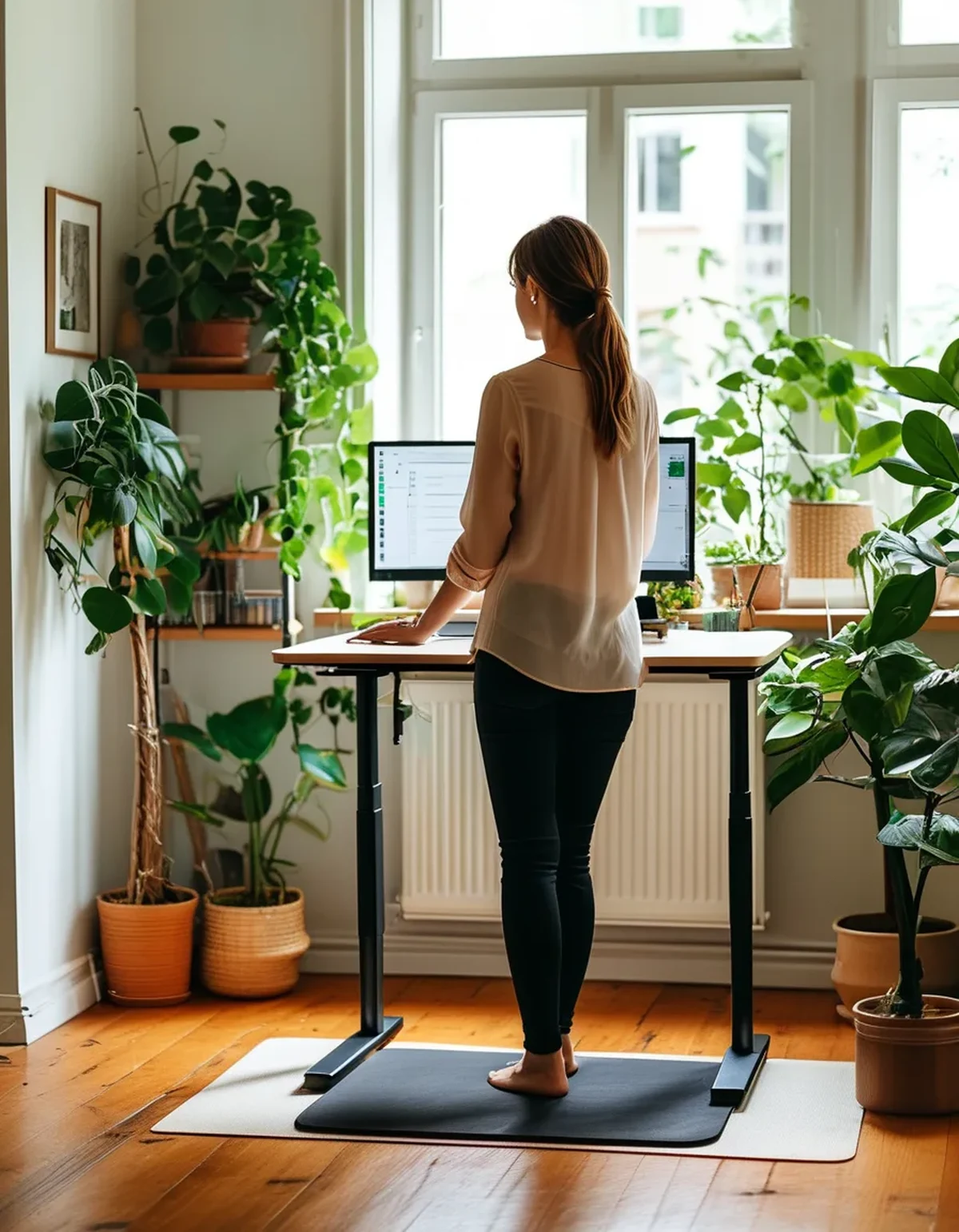
Seen here: High Waist Yoga Leggings with Side Pockets — shop it on bubblelime.com
Keep Reading
This article is for general informational and styling purposes only. Fit, sizing, and product availability may vary.