Why Your Walking Pad Feels Slower in a Cold Room
Quick Answer: Three things change in a cold room. The lubricant between belt and deck thickens, which raises friction and makes the belt drag slightly under each footfall. The motor works harder against that friction and can feel less responsive. And your own muscles are colder, so the same pace costs more effort for the first ten minutes. The belt drag is the part you can fix - relubricate at the start of the heating season, check belt tension, and let the machine run for two minutes before you step on.
The pad has been in the same corner all year at the same setting.
And since the room got cold it feels like walking through something rather than on top of it.

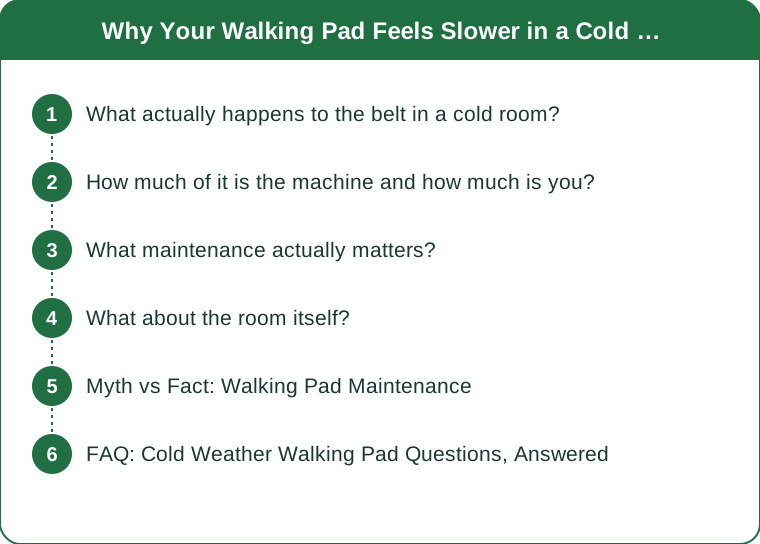
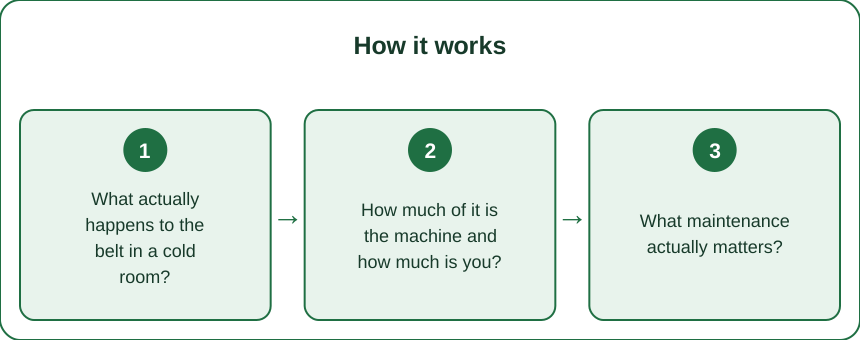
What actually happens to the belt in a cold room?
Silicone lubricant between the belt and deck thickens as temperature drops, which increases resistance the motor and the belt have to overcome.
Higher friction produces a small drag on each footfall, and while it is subtle per step, it is noticeable across a 45-minute session.
The belt material itself stiffens slightly, reducing how smoothly it runs over the rollers.
Motors draw more current against higher friction, which is why some machines feel less responsive to speed changes when cold.
Dry decks are dramatically worse. A pad overdue for lubrication is far more affected by cold than a well-maintained one.
And running the belt empty for two minutes warms the deck enough to reduce most of it, which is the cheapest fix available.
How much of it is the machine and how much is you?
Cold muscle produces force less efficiently, and the first five to ten minutes of any activity in a cool room genuinely cost more.
Joint fluid is more viscous when cold, so movement feels stiffer until things warm through.
Perceived effort runs higher at the start in a cool room and then drops below the summer equivalent once you are warm, which is why the session feels bad early and good later.
Cool rooms also mean more clothing, and layers restrict stride slightly and add a little weight.
Barefoot or sock walking on a cold deck changes gait, since people shorten stride when the surface feels cold and hard.
Which means part of the fix is patience - the first ten minutes are not representative of the session.
What maintenance actually matters?
Lubricate the deck at the start of the heating season, which is the single highest-value maintenance action and is overdue on most home machines.
Use only 100 percent silicone lubricant intended for treadmills, applied under the belt on both sides, and follow the manual on quantity.
Check belt tension. A belt that slips under your foot when you push off is too loose; one that will not lift a couple of inches at the centre is too tight.
Check belt centring, since a belt drifting to one side wears unevenly and adds friction.
Vacuum underneath and around the motor cover, because dust build-up is worse in autumn once the windows close and it makes the motor run hotter.
And check the surface it sits on - a walking pad on thick carpet runs hotter and less smoothly than one on a hard floor or a mat.

What about the room itself?
Do not store or use it in an unheated space if you can avoid it. Garages and conservatories are where cold-related problems concentrate.
Let the machine reach room temperature before use if it has been somewhere cold, in the same way you would with any lubricated mechanism.
Warm the room a few degrees before the session rather than during, since you want the deck warm before you step on rather than an hour later.
Keep it off thick carpet, which traps heat under the motor and interferes with the airflow the machine needs.
Watch the humidity, since damp autumn rooms encourage corrosion on rollers and hardware over time.
And leave a gap around it, which matters more once the room is closed up and there is less air movement.
Myth vs Fact: Walking Pad Maintenance
Myth: modern walking pads never need lubricating.
Fact: some are pre-lubricated for a period and very few are permanently maintenance-free. Check the manual for the interval, since running a dry deck is the fastest way to burn out a motor.
Myth: any silicone spray will do.
Fact: only 100 percent silicone treadmill lubricant. Household silicone sprays often contain solvents and propellants that damage the belt and deck surface.
Myth: a tighter belt is safer.
Fact: over-tensioning stresses the rollers and bearings and raises friction significantly. The belt should lift two to three inches at the centre of the deck.
Myth: the calorie readout is affected by the cold.
Fact: the readout is an estimate based on speed, time and sometimes weight. It does not know about friction, the room or your effort, and it was approximate to begin with.
Myth: the machine slowing down means the motor is failing.
Fact: far more often it is a dry deck or a mistensioned belt. Both are cheap to fix, and both cause motor failure if left, which is where the myth comes from.
FAQ: Cold Weather Walking Pad Questions, Answered
How often should I lubricate?
Most manufacturers suggest every three to six months of regular use, or roughly every 40 to 60 hours. Check your manual, since pre-lubricated decks differ.
Is it safe to use in a cold garage?
Most manuals specify an operating temperature range, and cold storage thickens lubricant and stresses electronics. An indoor location is much better for the machine.
Why does it feel fine after ten minutes?
Both the deck and your muscles have warmed up. Running the belt empty for two minutes before stepping on shortens that adjustment.
Can I put it on carpet?
Better on a hard floor or a treadmill mat. Carpet restricts airflow, traps heat and lets dust into the motor housing.
The belt slips when I push off - what does that mean?
Usually loose belt tension, sometimes a worn belt. Tension is adjustable with the rear roller bolts, a quarter turn at a time.
Should I walk barefoot on it?
Shoes give better shock absorption and a more consistent stride. A cold deck barefoot also tends to shorten the stride noticeably.
TL;DR:
- Cold thickens deck lubricant, which raises friction and makes the belt drag under each step.
- The motor works harder against that friction and feels less responsive.
- Your own cold muscles account for a real part of the first ten minutes.
- Lubricate at the start of the heating season with 100 percent silicone treadmill lubricant, and check belt tension.
- Run the belt empty for two minutes before stepping on, and keep the machine off thick carpet.
The pad did not get old over the summer. It got cold.
See It in Motion
Seen here: Super High Waist Embossed Yoga Leggings with Inner Pocket — shop it on bubblelime.com
Keep Reading
This article is for general informational and styling purposes only. Fit, sizing, and product availability may vary.