The Walking Pad Noise Problem Nobody Mentions Until the Neighbor Complains
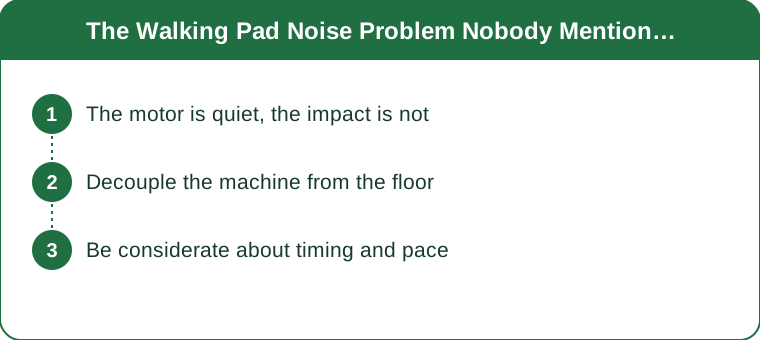
The motor hums. You can hear the podcast over it. You think, this is nothing — and then a note appears under your door. Almost every complaint about treadmills in apartments starts exactly this way: someone who genuinely wasn’t being loud, and a neighbor who genuinely couldn’t sleep.
Quick Answer: Walking pad noise complaints are almost never about the motor. They’re about impact vibration traveling through the floor structure into the ceiling below. Fix it with a high-density rubber mat (at least 1/2 inch thick, ideally 3/4) under the pad, walk instead of jog, and keep sessions between roughly 8 a.m. and 9 p.m. Those three changes resolve the large majority of downstairs complaints.
Why Do Neighbors Complain When the Machine Is Quiet?
Because you and your neighbor are hearing two completely different sounds.
You hear airborne noise — the motor, the belt, the fan. It’s high-frequency, it’s genuinely quiet on most walking pads (often in the 45–55 dB range, roughly a refrigerator), and it dies quickly in air.
Your downstairs neighbor hears structure-borne impact noise. Every footstep sends a low-frequency thud into the deck, through the machine’s feet, into your subfloor, along the joists, and out of their ceiling. Low frequencies travel through solid material far more efficiently than through air, and they pass straight through the drywall-and-insulation assembly that stops ordinary sound.
This is why the complaint feels so unfair. You’re standing on the machine hearing almost nothing. They’re lying in bed hearing a rhythmic thump every 0.6 seconds — which, incidentally, is the worst possible kind of noise for human tolerance, because it’s steady and predictable.
The tell: if the complaint mentions “thumping,” “pounding,” or “footsteps,” it’s impact noise. If it mentions “humming” or “whirring,” it’s the motor, which is rarer and usually means a worn belt or roller.

What Actually Stops the Vibration?
Decoupling — physically breaking the path between the machine and the building structure. A dense mat is the single most effective step, and it’s not close.
What to buy: a high-density rubber mat, 1/2 inch minimum and 3/4 inch if you can, sized larger than the pad’s footprint on all sides. Look for recycled-rubber gym flooring rather than a thin PVC “treadmill mat,” which is designed to protect your carpet, not to absorb impact.
How to stack it, in order of effectiveness:
- Rubber mat directly under the pad — handles most of it
- Rubber mat over an existing rug or carpet — the two layers of different density work better than either alone
- Add anti-vibration pads under the machine’s feet — the rubber pucks sold for washing machines, roughly $15 for a set of four
- Interlocking foam tiles under the rubber — an extra decoupling layer for older buildings with thin floors
What barely helps: a yoga mat (too thin, wrong density), a folded blanket (compresses to nothing), or moving the pad to a different room without changing the surface.
Placement matters too. Floors are stiffest near load-bearing walls and floppiest at the center of a span. Move the pad closer to a wall and you’re transmitting into the stiffest part of the floor, which vibrates less.
Does How You Walk Change Anything?
More than the mat, in some cases.
- Walk, don’t jog. Jogging roughly doubles peak impact force compared to walking. Most walking pads top out around 4 mph anyway, which is a hint about their intended use.
- Shorten your stride. A long stride lands heel-first with a hard heel strike. A shorter, quicker cadence — aim for about 120 steps per minute — spreads the force out.
- Land midfoot and quietly. The rule of thumb: if you can hear your own footfalls over a podcast at normal volume, your neighbor definitely can.
- Wear cushioned shoes, not bare feet or socks. Socks feel quieter to you and transmit more.
- Skip the incline if your model has one. Incline walking increases forefoot impact noticeably.
A 3.0 mph walk with a short stride on a 3/4-inch rubber mat is close to structurally silent. A 4.5 mph jog barefoot on bare laminate is a complaint waiting for a stamp.
5 Mistakes Everyone Makes
- Testing the noise from inside your own apartment. You cannot evaluate impact noise from the source. Ask a friend to stand in the hallway below, or knock on the neighbor’s door and ask directly.
- Buying the cheapest treadmill mat. A 1/4-inch PVC mat protects flooring and does close to nothing for vibration.
- Exercising at 6 a.m. or 11 p.m. These are exactly the hours when ambient building noise is lowest, so your thump has nothing to hide behind.
- Assuming carpet solves it. Carpet absorbs airborne sound and transmits impact almost unchanged. It’s a rug, not a spring.
- Waiting for the second complaint. The first one is a conversation. The second one goes to building management, and then it’s a file.
Number one is the one that catches everyone, because it’s the reason people insist the machine is silent right up until it isn’t.
How Do You Handle It If a Neighbor Already Complained?
Go down and talk to them, briefly and without defending yourself. Say you didn’t realize it carried, you’re getting a mat this week, and ask them to tell you if it’s still audible.
That conversation does something a mat can’t: it converts an anonymous nuisance into a person making an effort. Tolerance for noise goes up substantially when someone knows their neighbor is trying. Follow through within a few days, then check back once.
If you rent, it’s worth a quick look at your lease for quiet hours — many buildings specify 10 p.m. to 7 a.m. or similar. Staying inside those hours puts you on solid ground if the complaint escalates.
Comfort helps consistency too. A squat-proof high waist legging with a waistband that stays put means you’re not adjusting mid-walk, and a cushioned shoe does double duty for your joints and your downstairs neighbor.
FAQ
Are walking pads actually quieter than treadmills?
The motors are, meaningfully — walking pads are smaller, lower-powered, and usually belt-driven. But impact noise depends on your body weight and stride, not the machine, so a walking pad transmits nearly the same thud as a treadmill at the same speed.
What thickness of mat do I need?
Half an inch of dense rubber is the practical minimum; 3/4 inch is noticeably better. Density matters more than thickness — a thick soft foam mat compresses under load and stops absorbing anything.
Will a walking pad damage my floor or void my lease?
Damage is unlikely with a mat underneath, which also protects hardwood and laminate from the feet. Leases rarely prohibit exercise equipment outright, though many include general quiet-hours clauses worth checking.
TL;DR:
- The motor isn’t the problem — low-frequency impact vibration through the floor structure is
- A 1/2 to 3/4 inch high-density rubber mat is the single highest-impact fix
- Layer it: rubber over rug, plus anti-vibration pucks under the feet
- Walk at 3.0–3.5 mph with a short stride and cushioned shoes; skip jogging and incline
- Keep sessions to roughly 8 a.m.–9 p.m. and check your lease’s quiet hours
- Test from below, not from your own apartment — you can’t hear what they hear
The walking pad’s quiet motor hides the real apartment problem, and the real problem has a cheap, boring solution. Decouple the machine, shorten your stride, keep civilized hours, and it stays the considerate piece of equipment it was supposed to be.
See It in Motion
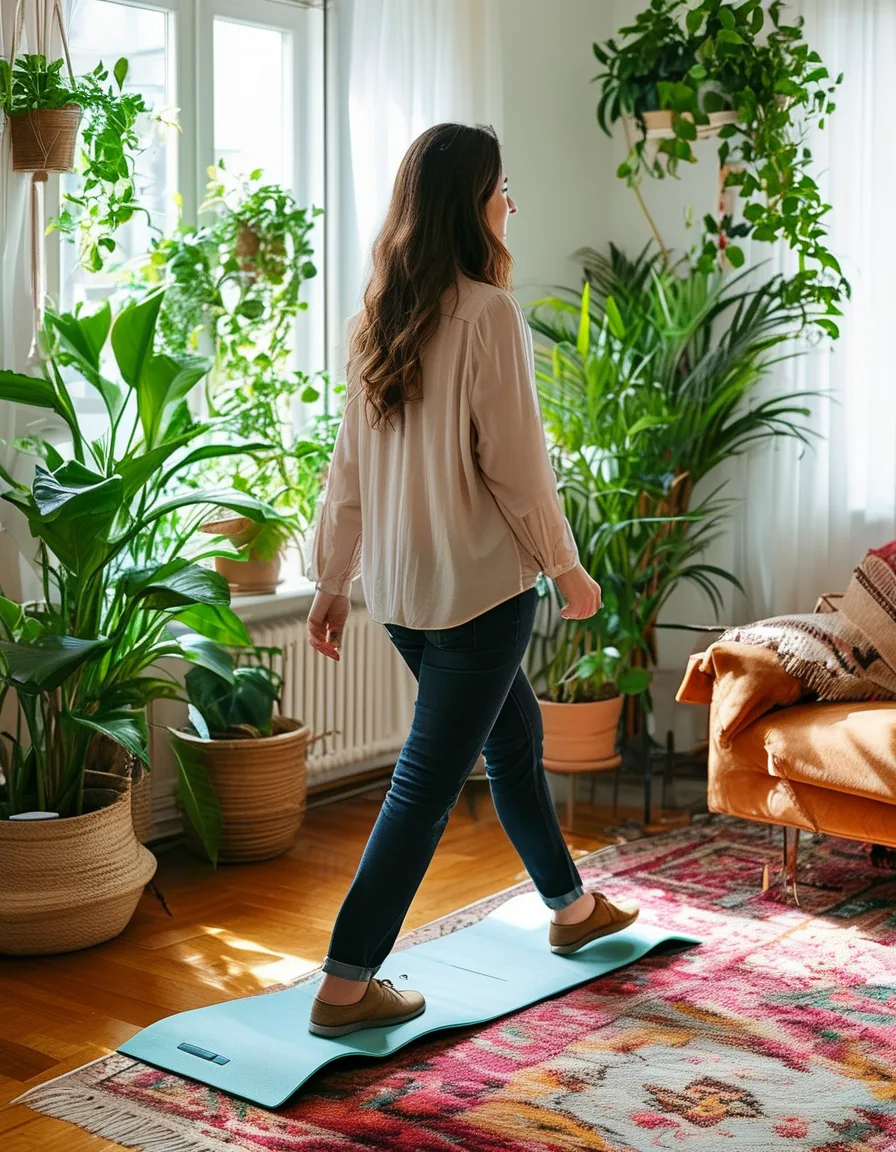
Seen here: Super High Waist Embossed Yoga Leggings with Inner Pocket — shop it on bubblelime.com
Keep Reading
This article is for general informational and styling purposes only. Fit, sizing, and product availability may vary.