Why Your Calves Ache After a Walking Pad Day — and the 3-Minute Fix
Quick Answer: Calf tightness after a walking pad day usually comes from walking too slowly for too long in shoes with a low heel drop on a short, firm deck. Slow walking shortens your stride and keeps your calf in a semi-contracted holding pattern for hours instead of going through a full lengthen-and-shorten cycle. Bump speed to 2.2 to 2.8 mph, break the day into blocks of 30 minutes or less, wear a shoe with some heel elevation, and do a 3-minute wall stretch and heel-raise sequence at the end of the day.
You did nothing but walk gently while answering email, and by 6 p.m. your calves feel like they went on a hike. That is not weakness. It is a very specific mechanical problem.
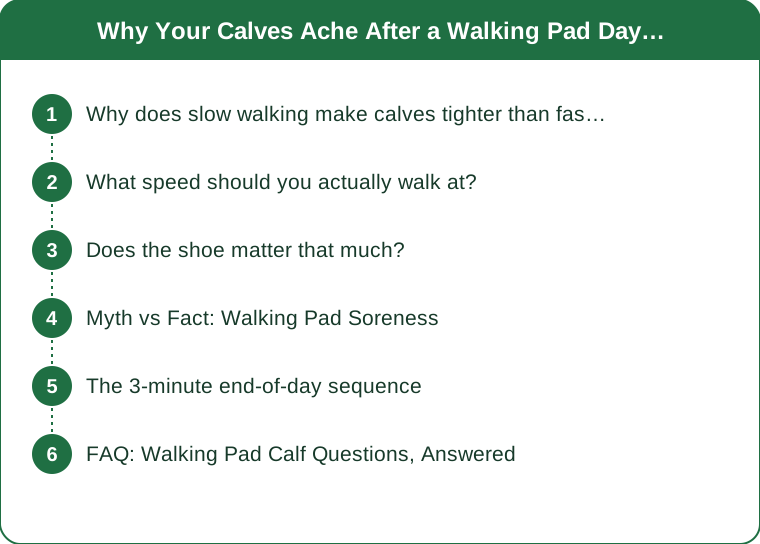
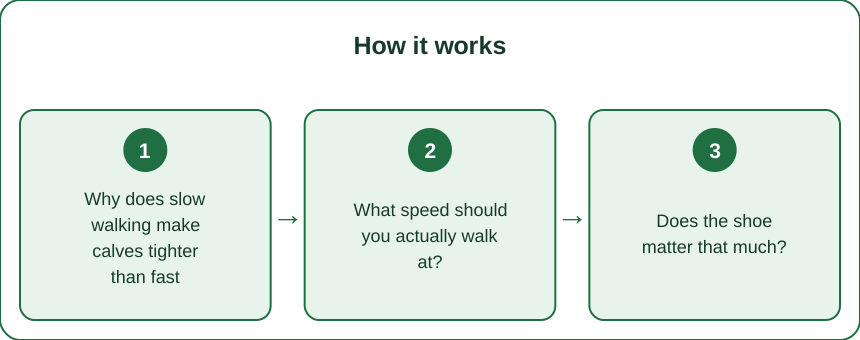
Why does slow walking make calves tighter than fast walking?
A normal walking stride has a big range of motion at the ankle. Your heel strikes, your calf lengthens under load as your body passes over the foot, and then it shortens hard to push off. That full cycle pumps blood through the muscle and resets its resting length constantly.
At 1.5 mph, which is where most people set a walking pad so they can type, that cycle collapses. Stride length shrinks, heel strike gets soft, and push-off nearly disappears. Your calf ends up doing small, repetitive, low-amplitude contractions for hours without ever fully lengthening.
Muscles held in a shortened range under continuous low load get stiff. It is the same reason your hips ache after a long flight, not the same reason they ache after a hard leg day. The fatigue is postural, not metabolic, which is why a stretch helps far more than a rest day.
What speed should you actually walk at?
The sweet spot for most people is 2.2 to 2.8 mph. That is fast enough to restore a real heel-to-toe roll and a genuine push-off, and slow enough that your typing accuracy survives.
If you cannot type at 2.5 mph, that is a signal about your desk height rather than your speed. Most people set the desk for standing and then add a pad underneath, which raises them four to five inches and forces the shoulders up. Lower the desk by the height of the deck.
Try this test: walk at your usual speed for two minutes and notice whether your heel actually contacts the belt first. If you are landing flat-footed or shuffling, you are below your natural transition speed and your calves are absorbing the difference.
Change speed through the day rather than picking one. Two or three minutes at 3.0 mph every half hour resets the muscle far better than a constant crawl.
Does the shoe matter that much?
More than the pad does. Walking pads have a short, firm deck with minimal cushioning, so whatever your shoe does not absorb, your calf and achilles do.
A zero-drop or minimal shoe keeps your achilles at full length for the entire day. That is fine for a 30-minute walk and punishing across four hours. A shoe with a 6 to 10 mm heel-to-toe drop gives the calf a small amount of slack and noticeably reduces end-of-day tightness for most desk walkers.
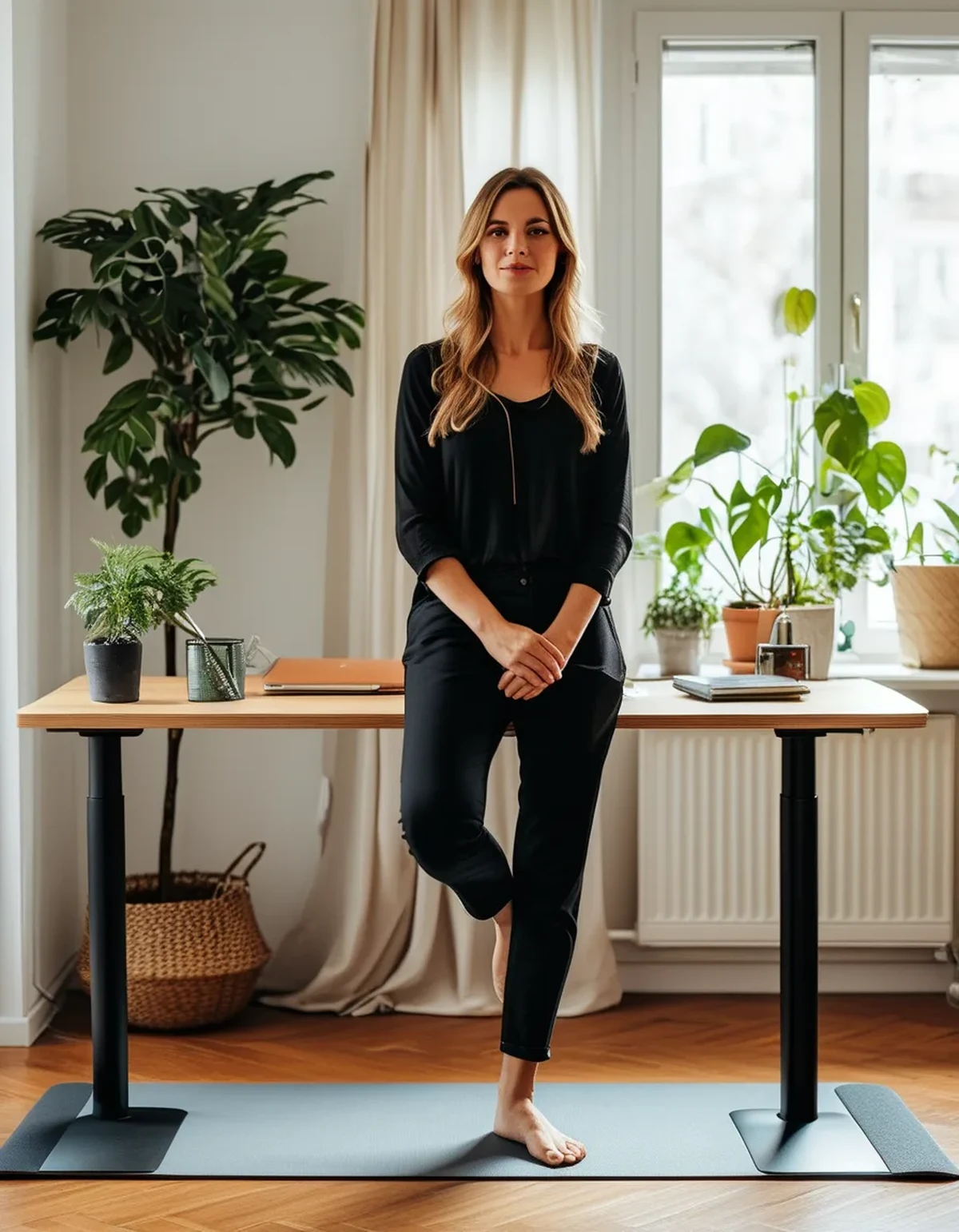
Barefoot or socks is the worst option on a walking pad, despite being the most tempting. There is no shock absorption, the belt surface grips unevenly against skin, and your toes grip to stabilize, which recruits the calf even harder.
Keep a dedicated pair by the desk. Shoes worn outdoors carry grit that shortens belt life, and a shoe you only wear indoors stays cleaner and lasts longer.
Myth vs Fact: Walking Pad Soreness
Myth: Sore calves mean you are getting a good workout. Fact: Postural tightness from a shortened range is not training adaptation. A genuine training stimulus at walking intensity would show up as general leg fatigue, not a specific band of tightness in one muscle.
Myth: You need to build up slowly, so start at 1.0 mph. Fact: The build-up should be in duration, not slowness. Start at a natural walking speed for 15 minutes, not at a shuffle for 90.
Myth: Stretching before helps more than after. Fact: For this problem, the useful stretching is at the end of the day when the muscle has been shortened for hours. Before is fine but does nothing about the accumulation.
Myth: A thicker mat under the pad will cushion your stride. Fact: Mats under the pad are for noise and floor protection. Almost none of that cushioning reaches your foot through a rigid deck.
The 3-minute end-of-day sequence
Do this when you shut the laptop, not the next morning.
1. Wall calf stretch, straight knee — 45 seconds per side. Hands on the wall, back leg straight, heel pressed down, hips forward. This targets the gastrocnemius, the upper part that gets the tightest from short strides.
2. Wall calf stretch, bent knee — 30 seconds per side. Same position, back knee softly bent. This shifts the stretch to the soleus underneath, which is the muscle that does the quiet work of slow walking and almost never gets stretched.
3. Slow heel raises off a step — 2 sets of 10. Rise up over two seconds, lower over four, letting the heel drop below the step at the bottom. This restores the full lengthen-and-shorten cycle your walking day never provided.
That is three minutes. Do it four days out of five and the end-of-day ache usually disappears inside two weeks.
FAQ: Walking Pad Calf Questions, Answered
Is calf tightness a sign I should stop using a walking pad?
Rarely. It is a sign the speed, shoe, or duration needs adjusting. Genuine warning signs are sharp pain at the back of the ankle, morning heel pain on the first steps out of bed, or swelling. Those point to achilles or plantar fascia irritation and are worth a professional look.
How long should one walking block be?
Keep individual blocks to 30 minutes or less, then sit or stand still for a bit. Total daily time can be several hours, but continuous hours are what produce the shortened-range problem.
Will compression socks help?
They help with the heavy, swollen feeling from long standing, and some people find them useful. They do not address range of motion, which is the actual cause here, so treat them as a comfort add-on rather than the fix.
This is general information, not medical advice. Persistent or sharp pain deserves a professional assessment.
TL;DR:
- Slow walking, not hard walking, is what tightens calves — it keeps the muscle in a shortened range for hours.
- Move your working speed to 2.2 to 2.8 mph and add short 3.0 mph bursts every half hour.
- Wear a shoe with a 6 to 10 mm heel drop, kept by the desk and never worn outside.
- Cap continuous blocks at 30 minutes, and lower the desk to account for the deck height.
- Do the 3-minute stretch and slow heel-raise sequence at the end of the workday, not the next morning.
The fix here is almost embarrassingly small. Faster speed, better shoe, shorter blocks, three minutes at the end. Most people who quit a walking pad quit because of this exact ache, and it was never the pad’s fault.
See It in Motion
Seen here: High Waist Embossed Yoga Leggings with Side Pockets — shop it on bubblelime.com
Keep Reading
This article is for general informational and styling purposes only. Fit, sizing, and product availability may vary.